
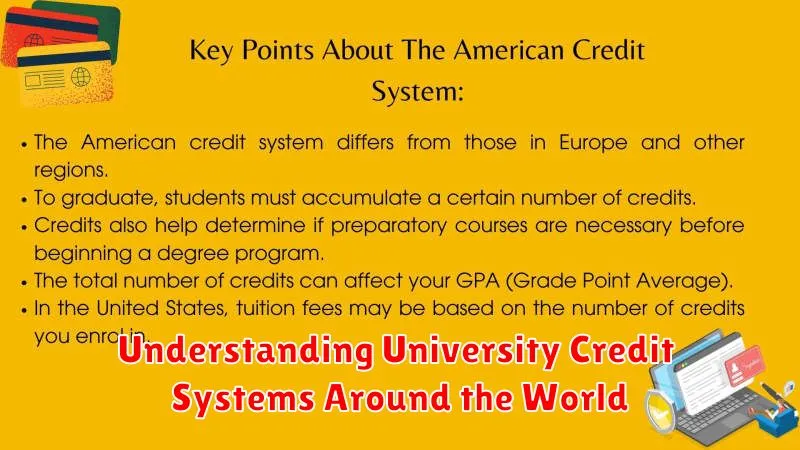
Navigating the complexities of higher education involves understanding university credit systems, which vary significantly across the globe. This article delves into the diverse landscape of university credits, exploring the different models employed internationally, from the widely used ECTS credits in Europe to the credit hour system prevalent in North America and other regions. Understanding these credit systems is crucial for students considering international study, enabling them to compare programs, transfer credits, and ensure their academic progress is recognized globally. Whether you are planning to study abroad, researching international education systems, or simply curious about how university credits work, this comprehensive overview will provide valuable insights.
University credit systems serve as a standardized measure of learning workload and achievement. They quantify the time and effort students are expected to dedicate to a particular course or module. This article will examine the key differences between various credit systems, including the US credit hour system, the European Credit Transfer and Accumulation System (ECTS), and other prominent models used worldwide. By examining the nuances of these systems, we aim to provide clarity and guidance for students, educators, and administrators navigating the intricacies of international higher education and credit transfer processes.
What Is a University Credit?
A university credit is a standardized unit that quantifies the amount of learning a student has achieved in a specific course. It represents the time commitment, including classroom instruction, study, and assignments, expected for a student to master the course content. Credits are crucial for tracking a student’s progress toward degree completion.
Credit hours often reflect the time spent in class each week during a semester or term. For example, a course with a 3-credit hour designation typically involves three hours of in-class instruction per week. However, the total workload for a course often extends beyond the in-class time, encompassing assignments, readings, and independent study.
Credits provide a consistent measure across different courses and institutions, facilitating the transfer of credits between universities. They also form the basis for calculating a student’s Grade Point Average (GPA) and determining academic standing.
Differences Between Semester and Quarter Systems
Two common academic calendars used by universities are the semester and quarter systems. The primary difference lies in the length of the academic term. A semester system typically divides the academic year into two roughly 15-week sessions (fall and spring), often with a shorter summer session. A quarter system divides the year into four roughly 10-week sessions (fall, winter, spring, and summer).
This difference in term length impacts the pace of learning. Quarter systems cover material more quickly, requiring students to assimilate information at a faster rate. Semester systems offer a more extended period to delve into subjects.
The number of courses taken per term also differs. Students in a quarter system usually take fewer courses concurrently than those in a semester system. Credit hours are also affected. A course that might be worth 3 credits in a semester system could be worth 4 or 5 credits in a quarter system to reflect the same amount of overall learning.
The ECTS Credit System in Europe
The European Credit Transfer and Accumulation System (ECTS) is a standard for comparing the study attainment and performance of students of higher education across Europe. ECTS credits represent the workload and defined learning outcomes of a course or program. This facilitates the recognition of academic qualifications and simplifies the process of transferring between institutions within the European Higher Education Area (EHEA).
Typically, 60 ECTS credits are awarded for one academic year of full-time study, equivalent to 1500-1800 hours of student workload. One ECTS credit corresponds to approximately 25-30 hours of work. This workload includes all learning activities, such as lectures, seminars, independent study, examinations, and so on.
ECTS helps students gain transparency and understanding of the structure and content of different programs across various European universities. It promotes mobility by making it easier for students to transfer credits earned during a period of study abroad towards their degree program at their home institution.
How Credits Work in the U.S.

In the United States, university courses are assigned credit hours, which represent the estimated amount of work a student is expected to complete for that course. Credit hours typically reflect the number of hours spent in class per week over a semester. For example, a course that meets for three hours a week over a 15-week semester is likely to be worth 3 credit hours.
A standard Bachelor’s degree typically requires the completion of around 120 credit hours. This translates to roughly 30 credit hours per year over a four-year period. However, the exact number of credits required can vary depending on the institution, the specific program of study, and whether the student transfers credits from other institutions.
Accumulating credits is essential for progressing towards graduation. Students must typically maintain a minimum GPA and successfully complete the required number of credit hours in their chosen field of study. Some universities also require a certain number of credits in general education or elective courses.
Credit Transfer Between Institutions
Transferring credits earned at one institution to another can be a complex process, impacted by factors like the receiving institution’s policies and the comparability of coursework. Compatibility of credit systems plays a key role. Institutions using the same credit system (e.g., ECTS) often have smoother transfer processes.
Articulation agreements between institutions can simplify credit transfer. These agreements pre-determine how credits earned at one institution will be accepted by another. Students should consult with advisors at both institutions to understand transfer policies and ensure a seamless transition.
Even with agreements, course equivalency isn’t always guaranteed. The receiving institution evaluates the course content, learning outcomes, and credit hours to determine how it aligns with their own offerings. Grades earned in the transferred courses are often factored into the GPA calculation at the receiving institution, although policies vary.
Tracking Your Graduation Requirements
Staying on track with your graduation requirements is crucial for timely completion of your degree. Universities provide various tools to help students monitor their progress. These often include online portals where you can view completed courses, grades earned, and remaining requirements.
Degree audits are a valuable resource. These reports provide a snapshot of your progress, highlighting fulfilled and outstanding requirements. They can also identify potential issues, such as missing prerequisites or insufficient credits within a specific subject area.
Academic advisors play a key role in helping you understand and meet your graduation requirements. Regular meetings with your advisor are highly recommended. They can offer personalized guidance, clarify program specifics, and help you make informed course selections aligned with your degree goals.
How to Plan a Balanced Credit Load
Planning a balanced credit load is crucial for academic success. A balanced load allows you to effectively manage your coursework without feeling overwhelmed or under-challenged. Several factors contribute to determining the right credit load for you.
Course difficulty plays a significant role. Advanced courses or those known for rigorous workloads may require more time and effort, even if they carry the same number of credits as other courses. Personal commitments outside of academics, such as work or family obligations, should also be considered.
Your own learning style and pace are also important factors. Some students thrive with a heavier workload, while others perform better with fewer courses. Starting with a moderate credit load and adjusting based on your experience is often recommended.
University resources, such as academic advisors, can provide valuable guidance in selecting the appropriate credit load. They can help you understand course expectations and create a realistic academic plan. Consulting with them is highly encouraged.
